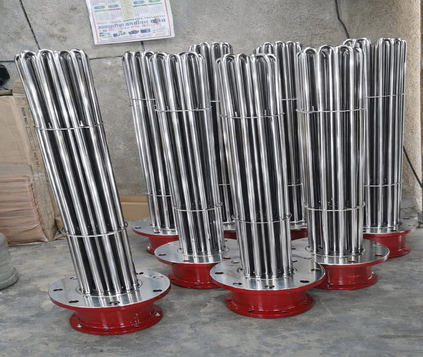
Immersion Heater
Immersion Heater Solutions
Heater Dekho offers advanced Immersion Heater Solutions designed for uniform, steady heating of large volumes of fluids in tanks and process facilities. Available in direct and indirect configurations, these heaters are engineered with suitable materials, optimized cold and active lengths, temperature controls, and robust support systems to ensure safe, efficient, and reliable heating performance across industrial applications.
Immersion Heater
Heater Dekho offers advanced Immersion Heater solutions designed for uniform, steady heating of large volumes of fluids in tanks and process facilities. Available in direct and indirect configurations, these heaters are engineered with suitable materials, optimized cold and active lengths, and suitable temperature controls for reliable and efficient heating performance.
Construction
Terminal Box: Heater Dekho flameproof heaters are certified to install in hazardous area Zone 1 & 2, Gas group IIC, IP66. The Terminal enclosure is designed to protect the terminals of the individual elements from external impacts, such as dust, moisture, etc., and to facilitate the connection of the incoming power supply to the heater bundle.
Heater Bundle: Consist of No. of U Pin heating elements adequately supported by a set of Baffles & Tie rods, designed to deliver the specified temperature at the outlet by maintaining the element temperature & pressure drop within the safe limits. Heating elements can be fitted to the heater flange by means of standard sleeve with brazing or direct welding or by means of threaded couplings. The heat duty of a bundle can be divided into many subgroups (banks) based on process conditions. This will help in better control and flexibility in the operation.
Temperature Sensors: The heater bundle will have Element skin temperature sensor for monitoring and regulating the Element skin temperature within the limits. The Unit may also need additional sensors such as Tube skin Temperature Sensor, Terminal Box Sensor, vessel Body temperature sensor, and process fluid temperature sensors based on case-to-case. The sensors used for the system will be certified in accordance with the area of installation. The Temperature sensors are typically RTD or Thermocouple. A simple heater bundle can also be controlled using Thermostat protection for skin & process temperature. If the Operation pressure is High, it is recommended to have a PSV (Pressure Safety Valve) installed within the Heater Vessel as an additional safety measure.
Control Panel: Heater controls panels are designed to monitor & control the operations of the heater bundle also ensure the safety of the equipment and operations. The control logic can be either ON/OFF (contactor) or regulated (Thyristor) or a combination of both in a single panel. The control panels can be installed in both safe areas & hazardous areas by following respective design guidelines & certification requirements.
The Control Panels are provided with various indication systems such as Power ON, Heater ON, OFF, Trip, High Temperature, etc. for controlling and monitoring of the process. The Temperatures of Elements, Process fluid & other areas (with sensors) are displayed on the Panel for better monitoring & awareness. Control Panel will also have safety interlocks such as high element temperature, Earth fault, process over-temperature, etc. along with Emergency stop access for safe operation and control.
Immersion Heater
| Based on the Direction of installation | Based on contact between element & fluid |
|---|---|
| Horizontal Immersion Heater | Direct Immersion Heater |
| Vertical Immersion Heater | Indirect Immersion Heater |
Direct Immersion Heater
An Electric Heater bundle in which the heating elements will directly immerse into the fluid to be heated is known as direct Immersion Heaters. The Direct immersion heaters are compact-sized heaters with direct heat transfer, making them a very effective method for heating large volumes of stored fluids.
Direct Immersion Heaters can be further designed as:
Horizontal Installed: Known as Horizontal Immersion Heater. Usually installed little above the bottom of the tank (always below the lowest fluid level).
Vertical Installed: Known as Vertical Immersion Heater. Usually installed from the top of the tank. A proper design is important to ensure correct cold length to avoid hot spots and dry heating in this design.
Vertical Installed with Horizontal: Specially designed heater bundle is installed from the top using a flange or threaded connection. The cold portion of the element will be vertical up to the minimum oil level. The active areas of the elements are bent at 90 degrees at a suitable level to form a horizontal immersion heater.
The mounting arrangement may be required with a flange or with a threaded nut assembly based on the rating and application. The heater can be designed for both safe area installation as well as hazardous area installation.
Direct Immersion heaters are most recommended due to their fast heating capacity and compact sizes.
Indirect Immersion Heater
There are many fluids in which installation of a direct immersion heater remains a challenge. While in some fluids the heating elements fail within a few days of installation due to corrosion caused by the fluid, there is also a risk associated with the skin temperature and flashpoint of the fluid.
Some unforeseen overheating or flashover may result in the accident (if control is not adequately supportive). For all such applications, Heater Dekho heaters have been designed as INDIRECT IMMERSION HEATERS.
The heating elements are fitted to threaded nuts and placed inside casing pipes welded to the heater flange. The heat transfer from the fluid through the casing pipe wall, which will be heated by the elements present inside. The heat transfers smoothly from the heating element to the fluid through the casing pipe wall, which will be heated by the elements present inside.
The Bundle is almost insulated with casing pipes as well as hazardous zones. The system provides full safety from any overheating & flashover inside the tank. Another advantage of an indirect immersion heater is <even in case of any failure of the single element, the replacement can be done without draining the tank. Hence the downtime & cost of maintenance spent is reduced to a great extent.
Technical Specifications
| Parameter | Specification |
|---|---|
| Rating | From 0.1 kW to 2500 kW (Max) in Single Bundle or combination |
| Design Temperature | -40 deg C to 650 degrees C |
| Design Pressure | Up to 350 bar(g) |
| Element Outer Sheath | SS, Alloy 600 series, Alloy 800 series, Hastelloy, Titanium, Copper, etc. |
| Heating Elements | A mineral-filled insulated Heating Elements or Tubular Heating Elements with NiCr (80-20) as heating coil and suitable outer sheaths. |
| Terminal Enclosure | As required (Weatherproof or Flameproof) |
| Control System | Thermostat control / Contactor control / Thyristor control / combination |
| Protections & Control | Element Skin Temperature Control, Process Temperature Control, Earth Leakage Protection, Overload Current Protection, Temperature Class Protection (for Hazardous area only) |
| Installation | Horizontal / Vertical / Direct / Indirect |
Advantages
- Heaters can be used for quick heating of small volume storage as well as for heating large volumes with longer operational hours.
- Widely used for heating high viscous fluids (Bitumen, HFO, etc.) and reducing the viscosity before pumping.
- Environment-friendly design. No hazardous gas/smoke/emission from the system.
- Precision Temperature control.
- Can be accommodated in small footprints.
- Custom designed to meet specifications.
- Highly energy efficient and provide maximum dielectric strength.
- Compatible with standard industry piping and safety standards.
- Reliable design.
- Easy to operate and maintenance-friendly.
Application
- At large Storage Tanks for preheating of thick fluids.
- Oil Heating (crude, Thermic fluids, other Process fluids, etc. in storage tanks).
- Water heating applications & vaporizer system.
- For reducing the viscosity of the fluid and make it suitable for pumping out.
- Steam Boilers.
- Oil cooling systems & compression packages.
- Edible oil heating for food industries.
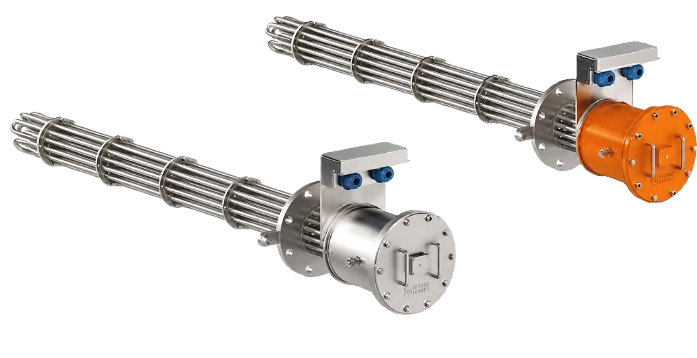
Types of Immersion Heater
Explore versatile finned tubular heater configurations designed for efficient air and gas heating across various industrial applications.
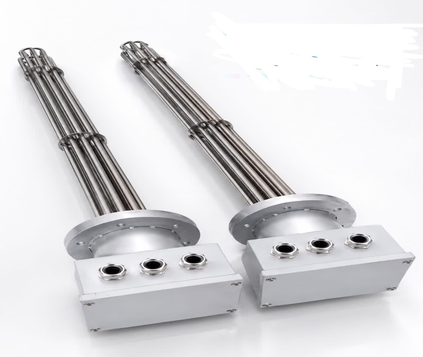
Immersion Heater